

Project Pegasus: What If Part of Our History Is Still Classified?
A boy at Gettysburg, Tesla's papers and alleged journeys to Mars: exploring Project Pegasus, the reality of secret research and the questions worth pursuing.
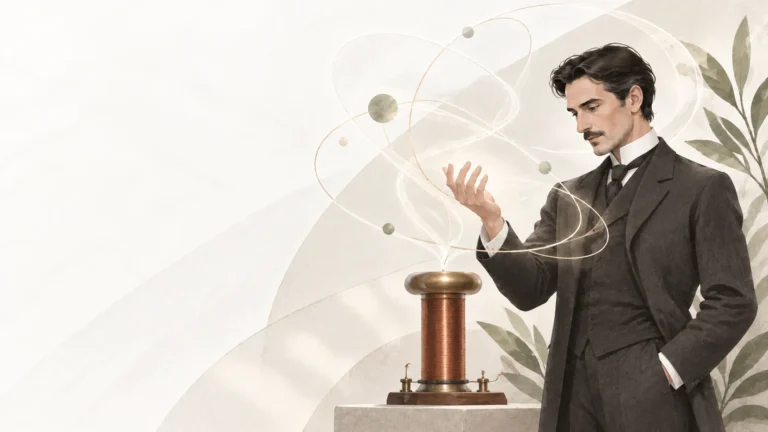
AI-generated conceptual illustration for Meravella: investigating the possibility of a hidden history. This is not an archival image or evidence of time travel.
The detail that stays with me is the missing shoe.
In Andrew D. Basiago’s account, a journey through time begins in New Jersey and ends at Gettysburg in 1863. Somewhere in the transition, the boy loses a shoe. He arrives in another century with an embarrassingly practical problem: he needs something to put on his foot before meeting Abraham Lincoln. The story places him in an old photograph, wearing replacement shoes too large for him. [1]
It is an extraordinary claim made memorable by an ordinary inconvenience. We can picture the shoe more easily than the machine.
That is where Project Pegasus becomes interesting to me. Beneath its spectacular claims lies a possibility worth examining: the public history of scientific progress may omit discoveries, experiments and failures that remain behind security barriers. We know that has happened. The harder question is how far the gap might extend.
Project Pegasus deserves a serious public inquiry. Scientific history cannot be complete while consequential research remains permanently beyond independent inspection. The witness account gives that concern a specific shape: a claimed childhood program, named places and dates, and technologies whose existence would transform ordinary life.
The boy who said he stepped into another century
Basiago describes Project Pegasus as a secret American program involving children and travel through space and time. In a 2010 letter, he says his involvement began in earnest in 1969, that boys and girls participated, and that he traveled from East Hanover, New Jersey, to Gettysburg in spring 1972, aged ten. His claimed destination was November 19, 1863. [2]
The video retelling turns the Gettysburg journey into a delivery mission. In its account, the boy approaches a machine in a large room, enters a luminous field and loses a shoe during the passage. At the other end, a man meets him and helps obtain oversized replacement footwear. They make their way toward Lincoln’s gathering. The story then claims that the letter reaches the president and a preset return brings the boy back to New Jersey. [1]
The shoe is no longer just picturesque. It creates a problem that another person supposedly solves, leaving the account with a helper, a delivery and a public scene in which someone might have photographed the traveler. Those details give the recollection its human texture. They also show how much more is being claimed than an unusual sensation inside a laboratory.
The same retelling describes six attempts to reach the moment of Lincoln’s assassination, each missing the required instant. The travelers encounter the aftermath, including people fleeing Ford’s Theatre, rather than the killing. Within the account, crossing into another era is an achievement whose precision remains difficult to control. [1]
Other episodes move from the American past to Mars. In Basiago’s written account, an elevator changes shape during the journey before opening into an underground base. He distinguishes physical travel from a device he says could view other times, presenting them as different capabilities within the wider research. [2]
The photograph makes the question concrete
The dedication at Gettysburg on November 19, 1863, was real, and photographs survive. A Library of Congress account describes six known views of the ceremony. The best-known, attributed to David Bachrach, shows Lincoln seated among the gathering. Basiago identifies a boy in a Gettysburg photograph as himself; that identification is a separate claim from the photograph’s authenticity. [3]
His 2010 letter also describes travelers being carried through the passage rather than walking along it. Returning to his own account gives us a more precise subject: what he says he experienced, at what age and in which place. [2]
The next step would be to place those particulars beside independently preserved records: a location’s history, contemporary documentation and the earliest available versions of the photograph. Details can become points of contact between an extraordinary recollection and an archive someone else can examine.
The Library’s account offers a useful comparison. Researcher Christopher Oakley describes combining the six photographs with maps and a digital reconstruction. A proposed platform position had to fit different photographers’ viewpoints at once. An arrangement that looked convincing in one view could fail against another. That is how separate records can constrain an explanation rather than simply repeat it. [3]
The exact image and crop asserted to show Basiago have not been matched and examined here, so I draw no conclusion about his face, clothing or shoes. The proposed identification should be investigated against the original image and its provenance. A public comparison would give the claim something more substantial than an endlessly recirculated caption.
Tesla’s papers and the reality behind the doorway
Tesla enters this story as the inventor whose work supposedly supplied a hidden technological foundation. His name carries enormous imaginative force: electricity, invention, unfinished possibilities, knowledge ahead of its time.
There is a documented event beneath the mythology. After Tesla died in January 1943, the Alien Property Custodian’s office temporarily seized his papers. The FBI’s historical account explicitly distinguishes that office’s actions from the familiar claim that FBI agents took possession of the papers themselves. [4]
The custody trail gives the inquiry an actual starting point. Which papers were taken, who examined them, what conclusions were reached and what records survive? An inventor’s legacy should be traceable through the institutions that held it. The documented seizure establishes that chain of custody, not a working time machine.
What I resist is the assumption that the public necessarily receives the whole scientific story as it unfolds. Published papers tell us what was published. A security system is designed, in part, to keep certain other work outside that record. How much it conceals in any particular field requires evidence, but its existence makes simple confidence in complete public knowledge hard to defend.
The classified world has already been stranger than polite opinion
Secrecy is capable of hiding very different kinds of work. The Manhattan Project employed about 130,000 people at its peak and cost roughly $2.2 billion by the end of the war. A vast, successful weapons program remained beyond most citizens’ knowledge while it was being built. [5]
The 1977 Senate hearing on MKULTRA records something different: covert drug testing on unwitting people, destroyed records and the later discovery of additional material. Here, the concealed fact was not merely technical capability but abuse of people. [6]
Then there is the CIA’s acknowledged remote-viewing research, begun in 1972. The agency’s retrospective account says that the work did not provide sufficiently reliable intelligence value to warrant restoring the program. The investigation existed; a dependable operational ability did not follow. [7]
A 2010 Defense Intelligence Agency reference document on traversable wormholes, stargates and negative energy occupies another category. It explores theoretical possibilities and demanding physical conditions. It does not report a working portal. [8]
These examples make secrecy a historical condition we have to investigate. They include a successful weapon, abusive experiments, an operational disappointment and speculative physics. Opening a record allows the public to discover which kind of history it contains. Keeping it closed allows an institution to decide how much of that history anyone else may know.
A breakthrough needs a physical account
The source connects Pegasus with earlier experiments and familiar scientific terms. Examining those connections can make the inquiry more specific: which apparatus, which effect, which event and which surviving record?
The Philadelphia Experiment is often presented as an ancestor of later teleportation programs. Yet the Naval History and Heritage Command’s account, based on the USS Eldridge’s movements, places the ship elsewhere during the relevant period and says it was never in Philadelphia in that interval. The Navy also explains the real practice of degaussing: reducing a ship’s magnetic signature against mines, which leaves it visible to human eyes. [9]
That chronology gives a future investigation a definite point to resolve. The ship’s movements and the circumstances of any alleged experiment should be set out together, where an independent researcher can compare them.
The word “teleportation” also needs care. In demonstrated quantum teleportation, information about a quantum state is transferred; a person’s body is not transported across the room or onto another planet. NIST makes that distinction explicit. The laboratory achievement does not establish the transportation system described in Pegasus testimony. [10]
Mars creates a further concrete problem. The accounts of a populated surface must meet what spacecraft have measured there. NASA’s Jet Propulsion Laboratory describes a thin atmosphere chiefly composed of carbon dioxide, with surface pressure less than one percent of Earth’s average. Any account of people moving around there must explain the life support or other conditions that would make it possible. [11]
A discovery on the scale described would have to bridge these specific physical differences. Its importance would lie in how it did so: the apparatus, conditions and repeatable effects that turned an extraordinary journey into a capability others could examine. Those are the details worth seeking.
Pegasus remains an unverified witness account in the accessible material examined here. That limitation defines the work still to do. It should focus inquiry on the places, records and claimed mechanisms, rather than turn unfamiliarity into a reason to refuse the question.
If the door existed, who would own the key?
The possibility becomes most unsettling when we consider its consequences.
Suppose, for the sake of examining the claim, that a restricted group could move people over great distances through a device. Transport would become a question of access to the system. The people controlling its entry points would have enormous influence over who could travel, where they could go and which borders still mattered.
Now add even limited access to information from the future. Imagine being able to investigate the outcome of a negotiation, the failure of a major investment or the consequences of a military decision before everyone else encountered them. The advantage would reach far beyond a remarkable invention. It would create an extraordinary imbalance between those who could consult that information and those who had to act without it.
These hypothetical consequences explain why the question matters beyond the spectacle of travel. A capability that changed humanity’s relationship with distance or time would affect people who had never consented to its use. Its custodians would be making decisions about a shared human future.
Basiago’s public campaign explicitly argues for disclosing alleged teleportation technology and making it available for broad human benefit. That aspiration is part of what gives the story its appeal. The claimed invention is presented as something humanity has been denied, rather than simply a machine someone wants credit for building. [12]
On the underlying principle, I take a firm position. A discovery with consequences on that scale should not become the permanent private jurisdiction of an intelligence bureaucracy. There can be legitimate reasons to protect dangerous operational details. Those reasons cannot justify unlimited exemption from accountable oversight, or the assumption that whoever first classified a discovery has the moral right to control it forever.
The account’s use of children raises an additional, conditional demand: if such experiments occurred, the participants would be owed an account of what was done, what risks were imposed and who accepted responsibility. National security cannot dissolve obligations to the people used in research.
Accountability would require people outside the program who could examine the evidence, investigate harm and challenge its custodians’ decisions. Some technical details might need protection; the authority to decide how the capability was used would still need limits. Even if Pegasus proved mistaken, that is a standard worth defending for the next discovery we have not yet been told about.
A prediction with something to lose
The video closes with a prediction attributed to Basiago: the United States would lower its presidential age requirement before 2030, and a woman in her twenties would become president in 2028. The version preserved here comes from that retelling; its original recording has not been recovered. [1]
Article II of the Constitution sets the minimum age at thirty-five. The prediction therefore contains two connected propositions: a change in eligibility and a particular kind of presidency. A woman becoming president at an older age would not fulfill the version reported here. Nor would a younger candidate merely announcing a campaign. [13]
As of October 2026, the specified year remains in the future. The useful thing to do is preserve the date, age and office now, so that the prediction can be compared with events on the terms in which it was made. Its constraints give the claim a point of contact with a future public record.
The outcome would become one part of the inquiry into the claimed foreknowledge. It would then need to be considered alongside the account’s origin, timing and other specific assertions. Preserving those details now protects the question from being rewritten afterward.
The historical investigation should continue wherever the records lead. Establishing an unfamiliar program, recovering its participants’ experiences or tracing an inventor’s papers could each add something important to public knowledge. The value of disclosure reaches beyond any single anticipated discovery.
The same independence is needed when reading official explanations and when listening to people who challenge them. As we argued in The Quiet Surrender of Critical Thinking, judgment involves accepting responsibility for what we conclude. Choosing an unconventional source does not remove that responsibility; choosing an official one does not remove it either.
I remain interested in Pegasus because the question it opens is larger than one man’s extraordinary recollections: what has been done, discovered or attempted without the public being allowed to know?
The public deserves access to that history and a credible way to challenge the decisions that keep it hidden. A discovery with consequences for everyone cannot be treated forever as the property of the first organization to classify it.
The missing shoe draws us toward a doorway in the story. The demand that should outlast our fascination is for the people who guard the records to answer: what lies behind it, and on whose authority is the public kept outside?
Sources:
[1] https://www.youtube.com/watch?v=Wb6LWyDB0Tk
[2] https://www.projectpegasus.info/docs/research_papers/Project-Pegasus-Andy-writes-Atlantis-Rising-correcting-Pegasus-Expose-6-25-10.pdf
[3] https://blogs.loc.gov/loc/2023/11/where-did-lincoln-stand-while-delivering-the-gettysburg-address/
[4] https://archives.fbi.gov/archives/news/stories/2008/july/myths_072408
[5] https://www.energy.gov/management/articles/manhattan-project
[6] https://www.intelligence.senate.gov/wp-content/uploads/2024/08/sites-default-files-hearings-95mkultra.pdf
[7] https://www.cia.gov/stories/story/ask-molly-did-cia-really-study-psychic-powers
[8] https://documents2.theblackvault.com/documents/dia/AAWSAP-DIRDs/DIRD_18-DIRD_Traversible_Wormholes_Stargates_and_Negative_Energy.pdf
[9] https://www.history.navy.mil/research/library/online-reading-room/title-list-alphabetically/p/philadelphia-experiment.html
[10] https://www.nist.gov/news-events/news/2019/05/nist-physicists-teleport-logic-operation-between-separated-ions
[11] https://www.jpl.nasa.gov/news/press_kits/insight/landing/facts/mars-at-a-glance/
[12] https://www.projectpegasus.info/
[13] https://www.archives.gov/founding-docs/constitution-transcript
More to read
Tesla, Free Energy, and the World Beyond Our Senses
Tesla’s extraordinary imagination, Si-Chen Lee’s experiments, the dream of free energy and the struggle over hidden knowledge raise a larger…

The Third Eye: Learning to See Beyond the Visible
Spiritual sight asks more of us than curiosity about hidden powers. The third eye brings us to the soul, the…

The Real Warning of 1984: Power That Cannot Be Questioned
The deepest warning in Orwell's 1984 concerns power that makes its claims impossible to challenge. Archives, privacy and enforceable remedies…